

Iqbal
Co-Founder, Chief Technology Officer

If you've been paying attention to SEO conversations over the past couple of years, you've almost certainly heard the term Core Web Vitals. And if you're like most business owners, you've nodded along without being entirely sure what it means in practice — or why it should matter to a business in Dubai trying to rank on Google.
Here's the short version: Core Web Vitals are a set of specific, measurable signals that Google uses to assess the real-world experience of using your website. They've been a confirmed ranking factor since 2021, and Google has continued to refine and expand their weight in search rankings through 2025 and into 2026. A website that fails these metrics is at a structural disadvantage in search results — regardless of how good its content is or how many backlinks it has.
For Dubai businesses competing in one of the most commercially active search markets in the Middle East, understanding and optimising for these metrics is not optional. Here's what you need to know.
What Core Web Vitals Actually Measure
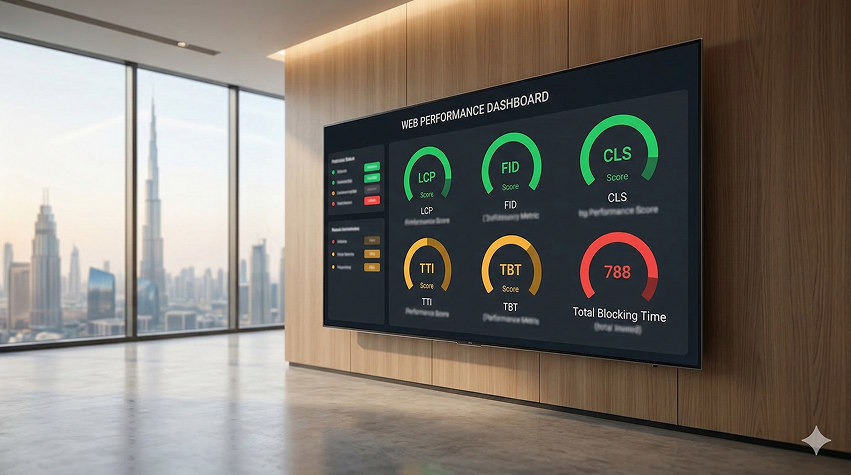
Google's Core Web Vitals currently focus on three primary metrics, each measuring a different dimension of user experience.
Largest Contentful Paint (LCP)
LCP measures loading performance — specifically, how long it takes for the largest visible element on the page to fully load. This is typically a hero image, a large block of text, or a video thumbnail. Google's threshold for a good LCP score is under 2.5 seconds. Between 2.5 and 4 seconds is considered needs improvement. Over 4 seconds is poor.
Most business websites in the UAE fail LCP not because of fundamentally broken architecture but because of unoptimised images, slow server response times, or render-blocking resources — all of which are fixable with the right technical attention.
Interaction to Next Paint (INP)
INP replaced the older First Input Delay metric in 2024 and measures responsiveness — how quickly your website reacts when a user interacts with it. Clicking a button, opening a menu, submitting a form. INP captures the full range of interactions throughout a page visit, not just the first one. A good INP score is under 200 milliseconds. Over 500 milliseconds is poor.
Websites built on heavy JavaScript frameworks, or those running a large number of third-party scripts — analytics, chat widgets, advertising tags — frequently struggle with INP. Every script that runs in the browser competes for processing time, and on lower-end devices or slower connections, that competition shows up as sluggish, unresponsive interfaces.
Cumulative Layout Shift (CLS)
CLS measures visual stability — how much the page layout shifts unexpectedly as it loads. You've experienced this as a user: you're about to tap a button and the page jumps, and you accidentally tap something else entirely. Or text moves around as images load in and push content down the page.
A good CLS score is under 0.1. Layout instability is most commonly caused by images without defined dimensions, dynamically injected content, or web fonts loading and swapping after the page has already rendered.
Why This Matters Specifically for Dubai and UAE Businesses
The Core Web Vitals conversation is global, but there are reasons it's particularly relevant for businesses operating in the UAE market.
Mobile-first usage patterns. The overwhelming majority of web traffic in the UAE comes from mobile devices. Core Web Vitals scores on mobile are typically worse than on desktop — images are heavier relative to screen size, JavaScript execution is slower on mobile processors, and network conditions vary more on cellular connections. A website that passes Core Web Vitals on desktop may still be failing on mobile, and Google's mobile scores are what primarily determine your ranking.
Competitive search landscape. Dubai is a commercially dense market. The businesses appearing in the top positions for high-intent local searches — "web development company Dubai," "ERP software UAE," "interior design Dubai" — are not there by accident. They have invested in both content and technical performance. If your website is technically deficient compared to competitors who have optimised theirs, you're fighting with one hand tied behind your back.
High consumer expectations. UAE consumers interact daily with some of the fastest, most polished digital experiences in the world — global e-commerce platforms, banking apps, government services that have been heavily optimised. The tolerance for slow, unstable, or unresponsive websites is low. Poor Core Web Vitals scores don't just affect your Google ranking — they reflect a real user experience problem that affects conversion regardless of how people find you.
How to Find Out Where Your Website Currently Stands
Before doing anything else, you need to know your current scores. There are several free tools that will give you this information.
Google PageSpeed Insights (pagespeed.web.dev) is the most direct tool — it gives you your Core Web Vitals scores for both mobile and desktop, identifies the specific issues causing problems, and prioritises them by impact. Enter your URL and you'll have a clear picture within seconds.
Google Search Console provides field data — real performance measurements from actual users visiting your site — rather than lab data from a simulated test. If your site has sufficient traffic, Search Console will show you your Core Web Vitals performance broken down by page type and flag pages that are failing.
Chrome DevTools and Lighthouse offer more detailed diagnostic information for developers who need to understand the technical root cause of performance issues rather than just the scores.
Start with PageSpeed Insights on your most important pages — your homepage, your main service pages, and your highest-traffic landing pages. The results will tell you exactly where you stand.
The Most Common Core Web Vitals Failures on UAE Business Websites
After working with businesses across the UAE on website performance, the same issues come up repeatedly.
Unoptimised images are the single most common cause of poor LCP scores. Large, uncompressed images — particularly hero images and banner graphics — dramatically slow down initial page load. The fix involves compressing images, converting them to modern formats like WebP or AVIF, and implementing lazy loading for images below the fold.
Too many third-party scripts cause INP problems on a large number of business websites. Every marketing tool, analytics tag, live chat widget, and social media pixel you add to your website runs JavaScript that competes for browser resources. Audit what's actually running on your site and remove anything that isn't earning its place.
Missing image dimensions are the most common cause of CLS issues. When a browser doesn't know how large an image will be before it loads, it can't reserve space for it in the layout — so when the image loads, everything shifts. Adding explicit width and height attributes to image elements is a straightforward fix.
Slow server response times affect everything. If your hosting environment takes 800 milliseconds just to respond to the initial request, there's a ceiling on how good your LCP can ever be regardless of other optimisations. Upgrading hosting, implementing server-side caching, or moving to a CDN-delivered architecture addresses this at the root.
Render-blocking resources — CSS and JavaScript files that the browser must fully download and process before it can display any content — delay LCP significantly. Deferring non-critical JavaScript and inlining critical CSS are standard optimisation techniques that have a meaningful impact on perceived load time.
Beyond the Three Core Metrics
While LCP, INP, and CLS are the current Core Web Vitals, Google has signaled that additional metrics may be incorporated into the framework over time. Two worth watching in 2026 are Time to First Byte (TTFB) — measuring server response speed — and Smooth Animations, related to the visual smoothness of transitions and scrolling.
Building a website with strong performance fundamentals — fast server infrastructure, lean code, optimised assets, and minimal third-party dependencies — positions you well regardless of how the specific metrics evolve.
Making the Business Case for Performance Investment
Website performance optimisation is sometimes a hard sell internally because the benefits are not immediately visible. You can't show a stakeholder a faster website the way you can show them a new homepage design. But the business case is strong when you frame it correctly.
A one-second improvement in page load time has been shown across multiple industry studies to increase conversion rates meaningfully — the exact figure varies by industry and baseline, but the direction is consistent. For an e-commerce business or a lead generation website doing significant volume, even a modest improvement in conversion rate represents real revenue.
Combined with the ranking benefit — appearing higher in search results for competitive Dubai keywords — the return on a focused Core Web Vitals optimisation project is typically faster than most businesses expect.
Where to Start
If your website is currently failing Core Web Vitals, the most effective approach is to prioritise fixes by impact rather than trying to address everything simultaneously. Start with LCP — it tends to have the biggest single impact on both user experience and ranking performance. Address the image and server response issues first, then move to INP and CLS.
If your website is built on a platform or theme that has fundamental performance problems baked into its architecture, optimisation has a ceiling. At some point, the conversation shifts from patching a slow website to rebuilding it properly — and in competitive markets like Dubai, that conversation is worth having sooner rather than later.
Your competitors are not waiting.


Not sure how your website scores on Core Web Vitals?
At Joyboy, we audit, optimise, and rebuild websites to meet and exceed Google's performance standards — so your business stays visible where it matters most. Get a free website performance review.