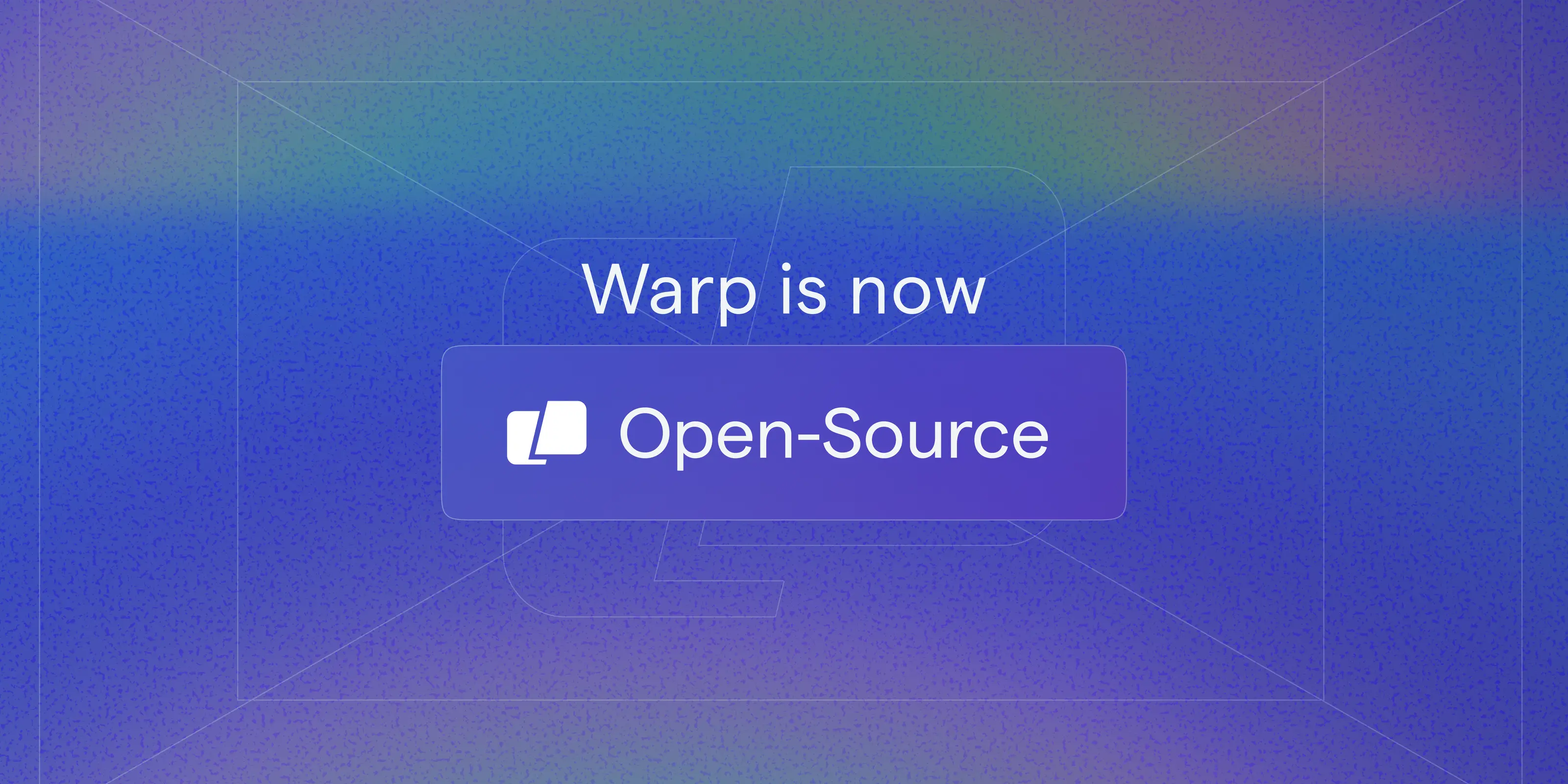
On April 28, 2026, Warp posted a three-word announcement: "Warp is now open-source." The tweet got 2.6 million views in two days. The GitHub repository accumulated 26,000 stars within hours of going live. And within the developer community, the reaction split almost immediately into two camps: people who saw this as a genuine milestone for open-source agentic development, and people who saw it as a sophisticated business move dressed up in community language.
Both camps are right. And understanding why requires looking at what Warp actually released, what it kept closed, and what the contribution model it introduced says about how software is going to be built from here.
What Warp Is, For Anyone Who Missed the Last Four Years
Warp started in 2021 as a Mac terminal. A reimagined command-line interface built in Rust, with blocks-based output that grouped commands and their results into discrete, selectable units — making the terminal readable and navigable in ways that traditional shells aren't. It raised $50 million from Sequoia, GV, Sam Altman, Marc Benioff, and Dylan Field. It expanded to Linux and Windows. And somewhere along the way it stopped being a terminal company and became what it now calls an Agentic Development Environment — a platform for running, managing, and orchestrating AI coding agents at scale.
Warp began in 2022 as, believe it or not, a terminal program for Macs. From there, it evolved into what the company calls an agentic development environment (ADE) and became available on Linux and Windows as well.
By April 2026, Warp was used by 700,000+ developers, including teams at Docker, Ramp, Peloton, leading AI labs, Big Tech companies, and over half of the Fortune 500.
For four years, the community had been asking — sometimes loudly — when Warp would open source. A 2021 GitHub discussion that accumulated nearly 200 upvotes and ran for years saw Warp CEO Zach Lloyd write that the company wanted to avoid a competitor forking Warp and starting another terminal company off it.
On April 28, 2026, that position changed. But how it changed is more interesting than the fact that it did.
What Was Released — and What Wasn't
Warp's source code is now available at github.com/warpdotdev/warp with an AGPL license.
Specifically: the client codebase in Rust is under AGPLv3. The UI framework crates — warpui and warpui_core — are under MIT, which is more permissive and lets people reuse those pieces without copyleft obligations. Themes and the workflows repo were already open before this.
What was not released: Oz itself — Warp's cloud agent orchestration platform — the server-side infrastructure, and the commercial features that drive Warp's revenue. The $12/month Pro tier still exists. Enterprise features still cost money.
AGPLv3 was almost certainly chosen to prevent cloud providers from running a hosted Warp clone without contributing changes back — the same defensive pattern MongoDB and Elastic used.
So what you have is a client-only release. The terminal is open. The agent orchestration layer that does the interesting work — Oz — stays proprietary. This is a clean implementation of a well-established developer tool business model: give away the client, charge for the cloud. Cursor does it. Vercel does it. Supabase does it.
Understanding this is essential context for evaluating everything else Warp announced.
The Contribution Model: Open Agentic Development
Here is where things get genuinely new.
Most open-source releases follow a familiar pattern: the code goes up on GitHub, a CONTRIBUTING.md file explains how to submit pull requests, maintainers review and merge. The work of implementation falls on human contributors — people who learn the codebase, write code, and submit it for review.
Warp's contribution model is different. The company wants agents doing the heavy lifting — coding, planning, testing — and community members helping with ideas, direction, and verification.
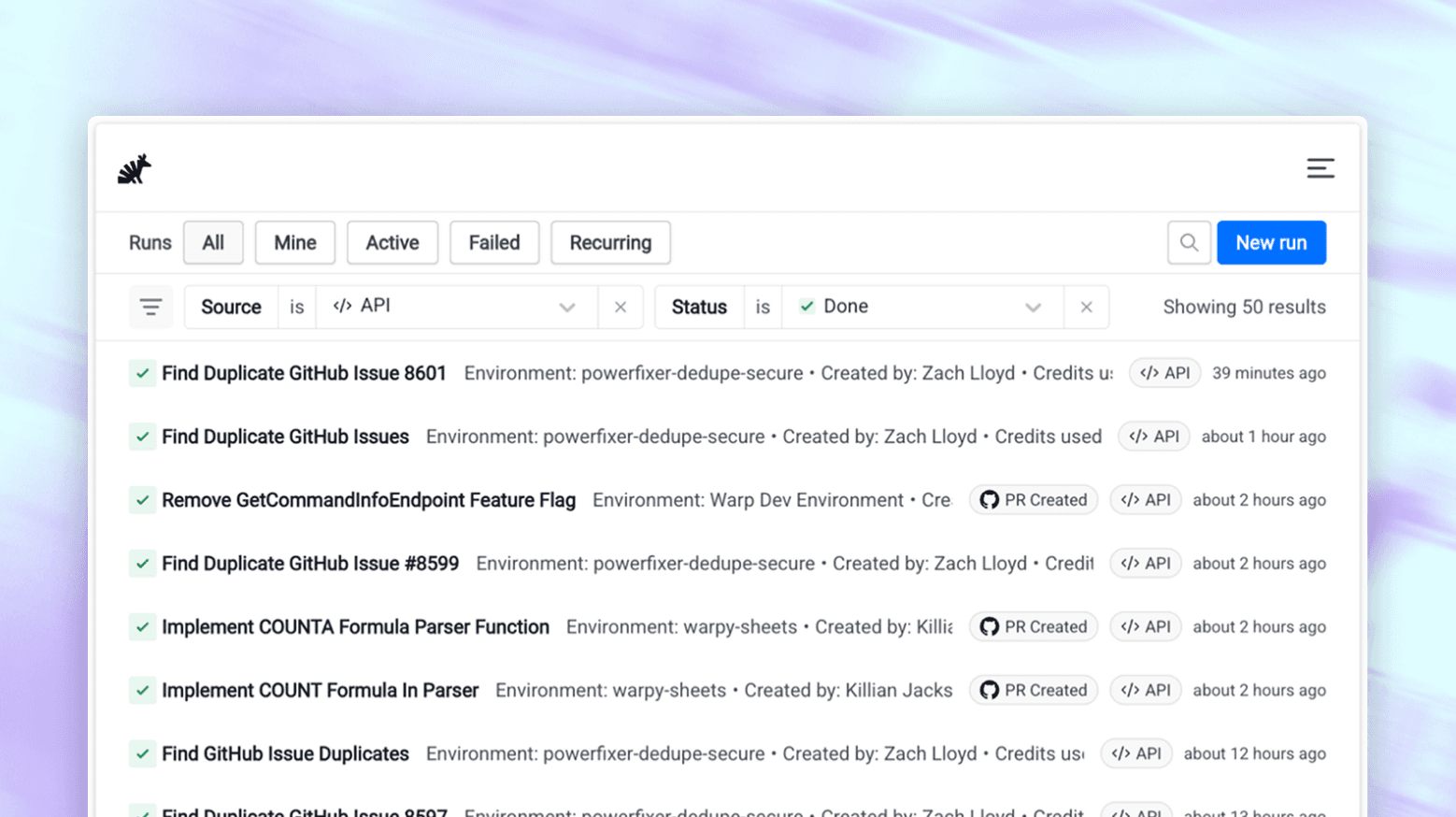
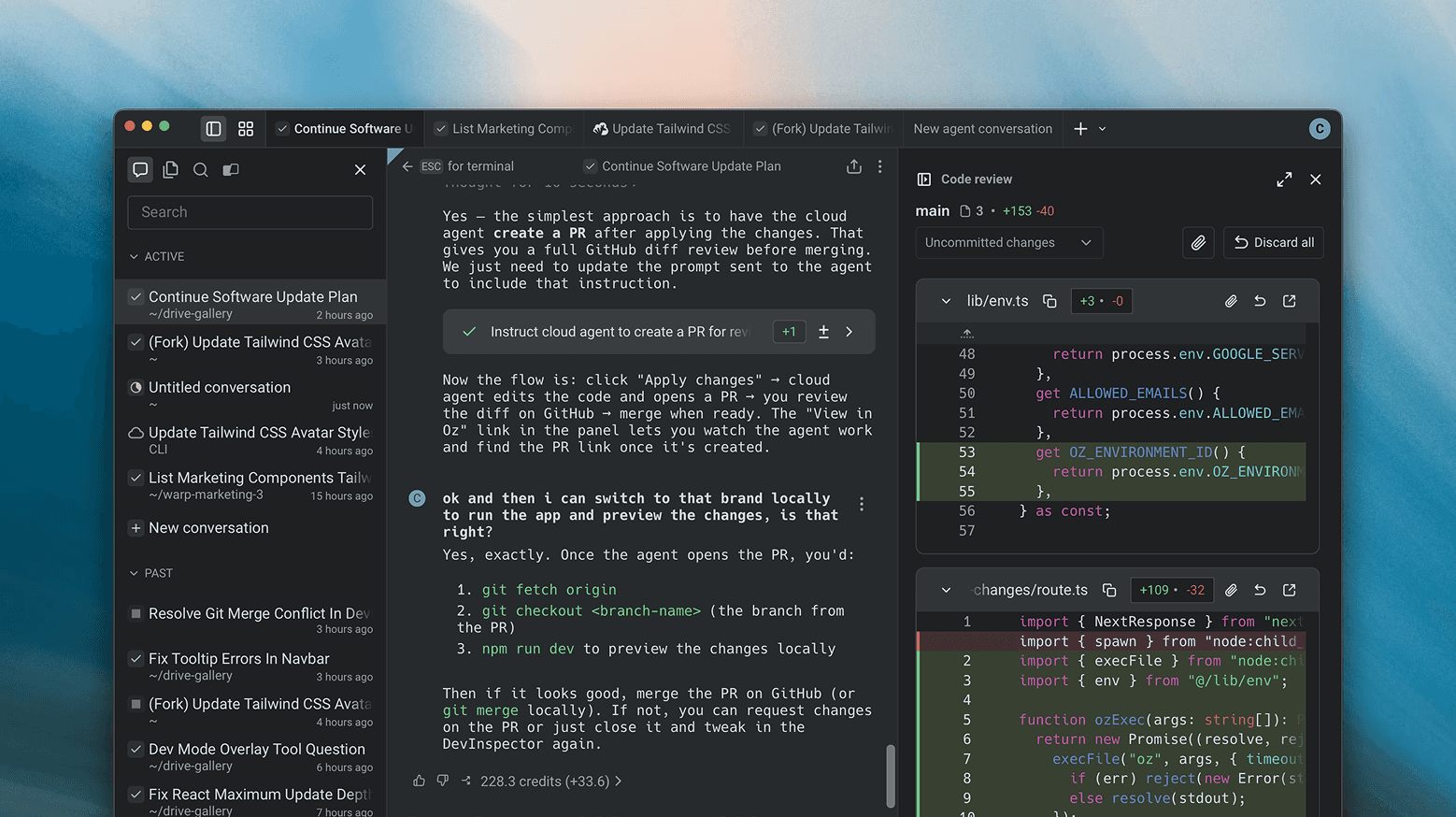
The system works like this: contributors file issues using templates. A Warp maintainer reviews the issue and may apply a readiness label — "ready-to-spec" signals the design is open for contributors to spec out, and "ready-to-implement" signals the design is settled and code PRs are welcome. Then Oz, Warp's agent orchestration platform, picks up the issue, asks clarifying questions, generates an implementation plan, writes the code, and opens a pull request — all visible in the open on GitHub.
Public GitHub issues now serve as the system of record for features, roadmap, and discussion. Oz manages the lifecycle by triaging issues, asking clarifying questions, generating implementation plans, writing code, and opening pull requests — all in the open, with session links, reviews, and progress visible to anyone.
The stated implication is significant: even non-technical users can contribute by articulating their ideas and verifying agent behaviour, without needing to learn the codebase or even how to write code.
Warp calls this model Open Agentic Development. The company sees it as its vision of how software will be built in the future — humans managing agents at scale to build production-grade software.
OpenAI as Founding Sponsor
The sponsorship announcement caught people's attention almost as much as the open-source release itself.
Warp's new open-source agent workflows are powered by OpenAI models, with OpenAI supporting the next generation of collaborative software development. Specifically, GPT-5.5 powers the agentic workflows that ship improvements to the codebase.
OpenAI engineering lead Thibault Sottiaux said: "Open source has long been central to how developers learn, build, and push the field forward. We're excited to support experiments that explore how AI can help maintainers and contributors collaborate more effectively at scale."
The strategic logic for OpenAI here is not subtle. The sponsorship positions Warp strategically against competitors like Claude Code — putting GPT models at the centre of a high-profile open-source developer tool used by nearly a million developers is meaningful distribution for OpenAI's coding capabilities.
Warp notes that contributors are free to use other coding agents as well, but says its preference is for Oz, which has the correct context and checks baked in for this workflow. And alongside the release, Warp is expanding open source model support, bringing in Kimi, MiniMax, and Qwen, plus a new "auto (open)" routing option that selects the best open model for a given task.
The Honest Questions the Community Is Asking
The Hacker News thread and developer community response to this announcement has been notably divided. The genuine excitement about the open-source release and the innovative contribution model coexists with sharp criticism that deserves to be acknowledged.
Critics accused the company of building on Alacritty — an open-source terminal — then raising $50 million without contributing back. One developer wrote: "if you're actually grateful for their support maybe you could support them with some donations out of that 50 million."
The competitive timing is also noted by multiple observers. Ghostty, written in Zig and fully free, has been picking up serious momentum as a lighter-weight alternative. Warp's differentiation isn't the terminal — it's the AI layer. By open-sourcing the client, Warp builds community adoption while keeping valuable components proprietary: Oz's agent orchestration, cloud platform, enterprise features.
The harder question is whether contributors who can already write Rust will want to file tickets for a GPT model to implement when they could just write the code themselves. The contribution model optimises for non-technical idea contributors and agent-assisted implementation — which is a genuine innovation, but it also limits the role of the experienced developers who typically drive the most impactful open-source contributions.
The real test is governance. Can the community influence which agents run, what they prioritize, and how they decide? Or will "open agentic development" mean Warp's agents implement Warp's roadmap, with community contributions limited to issue descriptions?
Warp's CEO Zach Lloyd addressed the business rationale directly: "Open-sourcing is fundamentally coming from our desire to build a successful business. We are competing with other highly funded, closed-source competitors, and we think opening and providing the resources for the community to improve Warp is a smart way for us to accelerate product development."
That's unusually honest for a launch announcement. It doesn't pretend the motivation is purely altruistic. It says: this is a competitive move, and we think it's the right one.
What the Oz Pipeline Actually Looks Like
For developers curious about the technical mechanics of how the agent contribution flow works, the repository makes it inspectable.
The CONTRIBUTING.md for the newly public repository makes Oz's role explicit: it automatically triages incoming issues, reviews open PRs, writes specs, and implements features. Contributors who accumulate merged PRs can request that Oz implement ready issues on their behalf, running on complimentary Oz credits.
The agent-readable context files under .agents/skills/, the spec format under specs/, and the WARP.md engineering guide are all designed to be consumed by coding agents — including, prominently, Oz itself.
The build flow for contributors who want to run Warp locally is straightforward:
Warp has also set up build.warp.dev as a live dashboard showing issue triage, agent activity, and what's available to pick up. This transparency — making the entire agent-managed pipeline visible in public — is one of the more interesting aspects of the release. You can watch the agents work. You can see what they're implementing, what decisions they're making, and where human review is applied.
What This Means for How Software Gets Built
Step back from the specific Warp announcement and there's a broader pattern worth paying attention to.
The Warp team concluded that development bottlenecks had shifted from code-writing to human-in-the-loop activities. Agents can handle the implementation heavy lifting really well. That frees contributors to focus on the higher-leverage work: shaping what gets built and making sure it's right.
This is not a small claim. It's a statement about where the constraint in software development has moved. For most of software's history, the bottleneck was writing code — there wasn't enough engineering capacity to build everything people wanted to build. The investment in developer productivity tools, languages, frameworks, and IDEs has all been an attempt to move that bottleneck.
If the bottleneck has genuinely moved from implementation to direction and verification — from writing code to knowing what code should be written and whether it's correct — then the optimal structure of a software team looks different. And the optimal structure of an open-source project looks different too.
Warp's open-source repository is structured to make Oz visible and credible to every developer who touches it. The entire open-source contribution workflow is, in effect, a live demonstration of what Oz can do. The terminal became the free on-ramp.
Whether you find that cynical or brilliant probably depends on whether you think the underlying technology actually delivers on the promise. Warp's Oz-driven workflow is now available to other open-source projects as well, extending the model beyond its own product. If it works — if projects beyond Warp adopt the model and it produces good software that the community actually wants — then the criticism about strategic motivation becomes secondary.
What to Watch For
The next three months will tell the real story.
Watch the issue velocity and the ratio of community PRs to Oz-generated PRs over the next quarter. That will tell you whether the trust buyback worked.
Watch whether non-technical contributors actually engage meaningfully with the roadmap, or whether the issue tracker fills up with requests that agents implement in directions the community didn't quite intend.
Watch whether other open-source projects adopt the Oz workflow — one more thing to watch: Warp says the Oz workflow is now available to other open-source projects, not just its own. Whether any sizable project actually adopts it will say something about how far "open agentic development" travels as a model.
And watch whether the community that spent years skeptical of Warp's closed model actually shows up now that the code is public. GitHub stars on launch day are not the same as sustained, meaningful contribution.
The repository is live at github.com/warpdotdev/warp. The agents are running. The contribution pipeline is open and visible to anyone who wants to look at it.
The experiment has started. We'll find out together whether it works.
Building developer tools or AI-integrated products for your team?
At Joyboy, we design and build custom software for businesses that want to stay ahead of where technology is going — not behind it. Talk to us about what you're building.