

Iqbal
Co-Founder, Chief Technology Officer

Automation has become one of the most talked-about topics in UAE business circles — and also one of the most confused. The terminology gets used interchangeably in ways that obscure meaningful differences, vendors position their products as solving problems they're not well-suited for, and business owners end up either investing in the wrong approach or avoiding automation entirely because the landscape feels too complicated to navigate.
RPA and AI automation are both genuinely useful. They are not the same thing, they don't solve the same problems, and choosing between them — or combining them — requires understanding what each one actually does and where each one earns its place.
Here is a clear, honest breakdown of both approaches, where each works best, where each falls short, and how to think about which one your business actually needs.
What RPA Actually Is
Robotic Process Automation — RPA — is software that mimics the actions a human takes when interacting with digital systems. An RPA bot can open an application, navigate its interface, read data from one place, copy it to another, click buttons, fill forms, extract information from documents, and trigger actions in other systems — all in the same way a human operator would, but faster, more consistently, and without breaks.
The critical characteristic of RPA is that it follows explicit, predefined rules. Every action the bot takes is programmed in advance. If the input looks exactly as expected and the system behaves exactly as configured, RPA executes flawlessly. If something outside those parameters occurs — an unexpected screen layout, an input format the bot wasn't programmed to handle, an exception that requires judgment — RPA either fails or routes the exception to a human for handling.
This rule-bound nature is both RPA's greatest strength and its fundamental limitation. It means RPA is extremely reliable for the processes it's designed to handle and completely unable to handle anything it wasn't explicitly programmed for.
RPA tools — platforms like UiPath, Automation Anywhere, and Blue Prism at the enterprise end, and more accessible tools like Power Automate at the mid-market level — work by interacting with the user interface of existing applications. This means RPA can automate processes in legacy systems that have no API, no integration capability, and no modern interface — as long as a human could operate it through a screen, an RPA bot can too. This is one of the reasons RPA became popular in large organisations with complex legacy technology stacks.
What AI Automation Actually Is
AI automation is a broader category that covers automation approaches where the system uses machine learning, natural language processing, computer vision, or other AI capabilities to handle inputs that are variable, unstructured, or require some degree of interpretation.
Where RPA follows explicit rules, AI automation learns patterns. Where RPA requires structured, predictable input, AI automation can handle variation. Where RPA fails when it encounters something unexpected, AI automation can generalise from what it has learned to handle situations it hasn't seen before — within limits.
In practical business automation contexts, AI automation shows up in several distinct forms.
Intelligent document processing uses computer vision and natural language processing to extract information from unstructured documents — invoices in varying formats, contracts, emails, scanned forms — without requiring those documents to follow a rigid template. A traditional RPA bot processing invoices needs every invoice to have the same layout. An intelligent document processing system can extract the relevant fields from an invoice regardless of how it's formatted.
Conversational AI powers chatbots and virtual assistants that handle customer enquiries, answer questions, route requests, and complete simple transactions through natural language interaction. Unlike a rule-based chatbot that matches keywords to predefined responses, a conversational AI system understands intent, handles variation in how questions are phrased, and maintains context across a conversation.
Predictive automation uses machine learning models trained on historical data to anticipate what action should be taken next — routing a support ticket to the most appropriate team member based on its content, flagging a transaction for review based on patterns that suggest anomaly, predicting which leads are most likely to convert based on behavioral signals. The system doesn't follow a rule that says "if X then Y" — it infers the appropriate action from learned patterns.
Generative AI in workflows — using large language models to draft communications, summarise documents, generate reports, or create content as part of an automated process — is a newer category that has moved rapidly from experimental to production use in 2025 and 2026. It introduces significant capability but also requires careful design around quality control and output validation.
The Fundamental Difference in Plain Terms
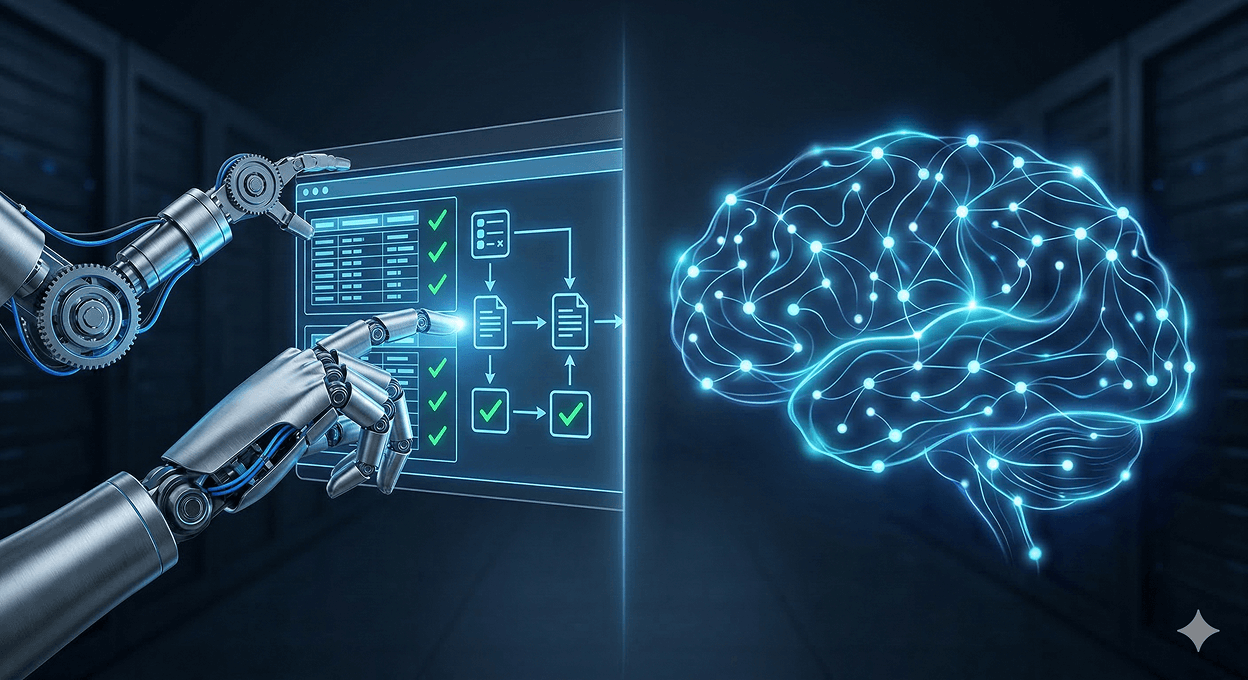
The clearest way to articulate the difference is this: RPA automates what a human does. AI automation attempts to replicate aspects of how a human thinks.
RPA is a very fast, very reliable robot that follows instructions exactly. Give it a clear process with consistent inputs and it will execute that process perfectly, every time, without fatigue or error.
AI automation is a system that can handle variation, interpret unstructured information, and make inferences — but with a level of reliability that depends on the quality of its training, the clarity of its design, and the variability of the real-world inputs it encounters. It is more capable than RPA in dealing with ambiguity, and less deterministic in its outputs.
Neither is inherently superior. They're suited to different problems.
Where RPA Earns Its Place
RPA is the right choice when the process you're automating has all of the following characteristics: it involves structured, consistent inputs; it follows clear, unchanging rules; it operates across existing digital systems that may not have modern integration capabilities; and the volume is high enough to justify the implementation cost.
Classic RPA use cases that deliver strong results in UAE business contexts include:
Finance and accounting operations. Extracting data from supplier invoices, validating it against purchase orders, posting it to accounting systems, and triggering payment workflows — when the invoice formats are consistent and the rules are clear, RPA handles this reliably at scale.
HR and payroll processing. Aggregating timesheet data, applying leave rules, calculating payroll components, and generating payslips — highly rule-based, high-frequency, and error-sensitive. A strong RPA candidate.
Data migration and synchronisation between legacy systems. When two systems need to share data but have no API integration, RPA can bridge the gap by operating both systems through their interfaces — reading from one and writing to the other exactly as a human operator would.
Regulatory reporting. Compiling data from multiple sources into a required reporting format and submitting it on a schedule — consistent structure, defined rules, high error sensitivity. RPA is well-suited and widely used for this purpose.
Where AI Automation Earns Its Place
AI automation is the right choice when the process involves variable or unstructured inputs, requires interpretation or inference, or needs to handle a range of situations that can't be fully anticipated and programmed in advance.
Customer service and enquiry handling. When customer enquiries arrive in natural language with varying intent, context, and phrasing, a rule-based system quickly reaches its limits. An AI-powered conversational system handles variation, maintains context, and can manage a significantly wider range of interactions without human escalation.
Document processing across variable formats. When the documents you need to process — invoices, contracts, applications, reports — come from multiple sources in multiple formats, intelligent document processing delivers what RPA cannot: reliable extraction regardless of how the source document is structured.
Lead scoring and sales prioritisation. Identifying which leads in a pipeline are most likely to convert, based on behavioral and demographic signals, requires pattern recognition across a large dataset — a machine learning problem, not a rules problem.
Content generation at scale. Drafting first versions of routine communications, summarising long documents, generating product descriptions from specifications — these tasks involve language understanding and generation that AI handles and RPA cannot approach.
The Combination That Works Best in Practice
In most real-world business automation programs, the most effective approach combines both RPA and AI automation — using each where it's genuinely suited rather than forcing one approach to handle everything.
A document processing workflow might use AI to extract and interpret data from variable-format incoming documents, then hand off to an RPA bot to post that structured data into backend systems through their existing interfaces. A customer service workflow might use conversational AI to handle initial enquiries and gather information, then trigger an RPA process to look up account details, create a ticket, and send a confirmation — tasks that are rule-based once the initial natural language interaction is complete.
This combination — sometimes called intelligent automation or hyperautomation — is where the most significant efficiency gains are being realised in 2026. It requires more thoughtful design than either approach alone, but it enables automation of end-to-end workflows that would be impossible with a single approach.
How to Decide What Your Business Needs
The practical decision framework is straightforward once you understand the difference between the two approaches.
Start by mapping the specific processes you want to automate. For each one, ask: are the inputs consistent and structured, or variable and unstructured? Do the rules that govern the process cover every situation, or are there cases that require interpretation? Is the process operating across existing systems that have no API, or are there integration options available?
Processes with structured inputs, clear rules, and legacy system dependencies are RPA candidates. Processes with variable inputs, interpretation requirements, or natural language involvement are AI automation candidates. Processes that have elements of both may benefit from a combined approach.
The other practical consideration is implementation complexity and ongoing maintenance. RPA implementations are generally more predictable in scope and more straightforward to maintain than AI automation implementations, which require training data, model management, and ongoing performance monitoring. For businesses new to automation, starting with well-scoped RPA projects builds confidence and delivers quick wins before moving to more complex AI automation implementations.
Cutting Through the Noise
The automation vendor landscape in 2026 is noisy. Every platform claims to do everything. AI gets applied as a label to tools that are doing very little that's genuinely intelligent. RPA vendors are adding AI capabilities with varying degrees of maturity. The marketing makes the decision harder than it needs to be.
The way to cut through it is to start from the problem, not the solution. Define clearly what process you want to improve, what inputs it deals with, what rules govern it, and what a successful outcome looks like. Then evaluate which approach — or combination of approaches — is genuinely suited to solving that specific problem.
Businesses that start from the technology and work backward to find problems it can solve tend to end up with impressive-sounding implementations that don't deliver meaningful operational value. Businesses that start from the problem and work forward to the right solution tend to end up with automation that compounds in their favor for years.
That distinction — more than any choice between RPA and AI — is what determines whether your automation investment pays off.

Not sure whether RPA, AI automation, or a combination of both is right for your business?
At Joyboy, we help UAE businesses cut through the noise and implement the automation approach that actually fits their operation — not the one that sounds most impressive in a pitch. Talk to us about your automation needs.