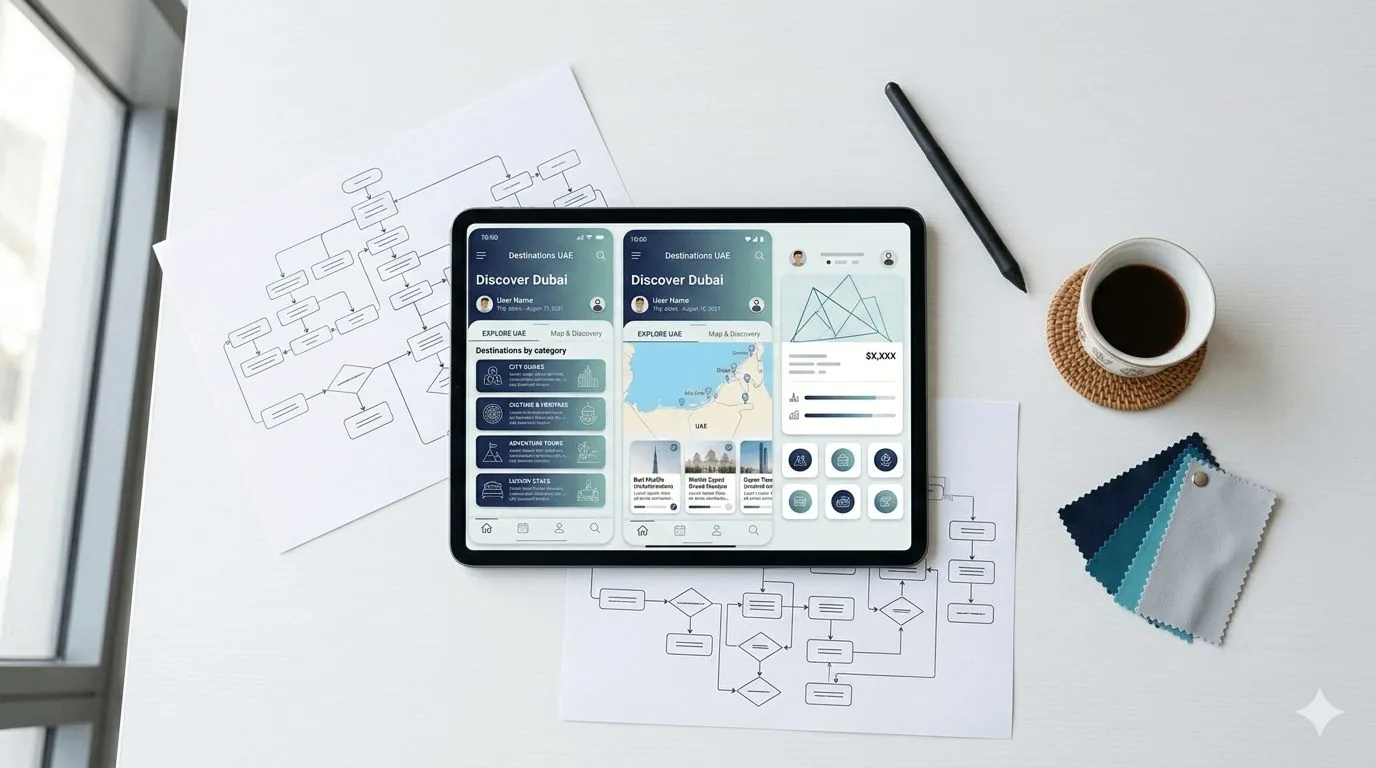
There's a conversation that happens regularly in product and business meetings across the UAE. The design budget comes up, someone asks whether the extra investment in proper UI/UX work is really necessary, and the discussion gravitates toward cutting it back in favor of getting more features built faster.
It's an understandable impulse. Design feels subjective. Features feel concrete. And when you're working with a finite budget and a real deadline, trading visible functionality for something as intangible as "better user experience" can feel like the wrong trade.
The businesses that have figured out that this thinking is backwards are the ones consistently outperforming their competitors in retention, conversion, and customer satisfaction. The ROI of good UI/UX design is real, measurable, and in most cases significantly higher than the ROI of the additional features that get built in its place.
Here's what that return actually looks like — and why it tends to be invisible until you know where to look.
The Conversion Rate Is a Design Problem
Every digital product has a conversion rate — the percentage of users who take the action the product is designed to drive. For an e-commerce app, it's the percentage of visitors who complete a purchase. For a SaaS platform, it's the percentage of trial users who convert to paid. For a lead generation website, it's the percentage of visitors who submit an enquiry.
Most businesses treat conversion rate as a marketing problem. They focus on driving more traffic, running more ads, optimising their targeting. What they underinvest in is the design of the experience that traffic lands in — which is where the conversion actually happens or doesn't.
A poorly designed checkout flow, a confusing onboarding sequence, a form with too many fields, a call-to-action button that doesn't stand out — each of these has a direct, quantifiable impact on conversion rate. And because conversion rate affects every user who reaches that point in the journey, even small improvements compound across your entire user base.
A 2% improvement in conversion rate on a product doing AED 500,000 in monthly revenue is AED 10,000 per month — AED 120,000 per year — from a design change that might have cost AED 15,000 to research, design, and implement. That's the kind of return that reframes the conversation about what design investment is worth.
Retention Is Where the Real Money Is
Acquisition gets most of the attention in product discussions. Retention is where most of the value actually lives.
The cost of acquiring a new user — through advertising, content marketing, referrals, or any other channel — is almost always significantly higher than the cost of keeping an existing one. A user who stays, returns, and continues engaging with your product generates compounding value. A user who churns after the first session generates almost none, regardless of how much it cost to acquire them.
Retention is overwhelmingly a design and experience problem. Users leave when the product is confusing, frustrating, slow, or when it fails to deliver the value it promised in a way that's easy to access. They stay when the experience is smooth, when they find value quickly, and when the interface respects their time and intelligence.
Investing in the design of the retention-critical moments in your product — the onboarding flow, the return visit experience, the moments where a user might disengage — directly affects the lifetime value of every user you acquire. Over a twelve-month period, the difference between a product with 20% monthly retention and one with 35% monthly retention is enormous — and that difference is largely a design outcome.
Support Costs Go Down When Design Goes Up
This is one of the least discussed returns on UI/UX investment, and one of the most consistent. When an interface is confusing, users get stuck. When users get stuck, they contact support. Support costs money — in staff time, in tooling, in the operational overhead of managing a support function.
A well-designed interface that anticipates where users get confused, surfaces help contextually, uses clear language, and provides obvious paths forward reduces support volume directly. Every design decision that eliminates a point of confusion is a support ticket that never gets raised.
For businesses running digital products at scale — particularly SaaS platforms, marketplaces, and fintech applications — the support cost reduction from systematic UX improvement can be substantial. It's not uncommon for a focused UX audit and redesign of the most friction-heavy flows to reduce support volume by 20–30% in those areas.
The Cost of Fixing Design Problems After Launch
One of the strongest arguments for investing properly in UI/UX design upfront is the cost of not doing so. Design problems that are caught during the research and prototyping phase cost a fraction of what they cost to fix after a product has been built and shipped.
Changing a user flow during wireframing is a conversation and a few hours of design work. Changing the same flow after it's been developed, tested, and shipped means developer time to rebuild it, QA time to retest it, a new App Store submission and review cycle, and the user experience impact of the broken version that was live in the interim.
Industry research on this cost multiplier varies, but the consistent finding is that fixing a usability problem in development costs roughly ten times what it costs to fix in design, and fixing it after launch costs significantly more again. This is not a theoretical calculation — it's a practical reality that plays out on product teams that skip or underscope the design phase.
Framed this way, the design budget isn't an additional cost. It's a risk mitigation investment that reduces the probability of significantly more expensive problems downstream.
Brand Perception Is Built Through Experience
In the UAE market, brand perception matters enormously. The way a business presents itself — the quality and care evident in every touchpoint — directly influences how potential customers assess its credibility, its pricing power, and its trustworthiness.
Your digital product is one of the most significant brand touchpoints you have. Users form impressions of your business based on how your app or website feels to use — whether it feels premium or cheap, considered or careless, modern or outdated. Those impressions influence purchasing decisions, referral behavior, and willingness to pay.
A product that looks and feels genuinely well-designed communicates something about the business behind it that no amount of marketing copy can replace. It signals that the company takes quality seriously, pays attention to details, and cares about the people using its products. In a competitive market, that signal has real commercial value — it affects conversion, it affects pricing power, and it affects the kind of customers you attract.
Measuring the ROI of UI/UX Investment
The return on UI/UX design is measurable, but it requires defining the right metrics before the work begins and tracking them consistently after.
The metrics worth tracking depend on what the design work is addressing, but typically include conversion rate at key funnel stages, user retention at day 1, day 7, and day 30, task completion rates for critical user flows, support ticket volume for specific features or flows, Net Promoter Score or in-app satisfaction ratings, and average session length and return visit frequency.
Establishing a baseline before design changes are implemented, then tracking the same metrics after, gives you a clear picture of what the design investment produced. In most cases, the numbers tell a compelling story — not because good design is magic, but because poor design creates so much friction that even moderate improvements generate meaningful lift.
The Compounding Effect
Perhaps the most important thing to understand about UI/UX investment is that its returns compound. A better onboarding flow improves retention. Better retention increases lifetime value. Higher lifetime value improves unit economics. Better unit economics give you more budget to invest in acquisition. More users experiencing a well-designed product generates more word-of-mouth and referrals.
Each improvement builds on the last. The businesses that treat design as an ongoing investment — not a one-time project — accumulate a product quality advantage over time that becomes genuinely difficult for competitors to close.
The businesses treating design as a cost to be minimised are optimising for the wrong thing. The ones treating it as a lever for growth are building something that compounds in their favor with every release.
That's the hidden ROI of UI/UX design. It was never really hidden — it just requires looking at the right numbers to see it clearly.

Wondering what better design could do for your product?
At Joyboy, we design interfaces that do more than look good — they convert, retain, and grow. Let's talk about what intentional UI/UX design could mean for your business. See how we approach design.