
There's a version of this conversation that happens in businesses of every size. Someone mentions that a particular process is slow, frustrating, or error-prone. Someone else says they've been thinking about that too. A third person mentions they have a spreadsheet that helps but it keeps breaking. Everyone agrees something should be done about it. And then the meeting ends, everyone goes back to their desk, and the process continues exactly as it was — because fixing it feels complicated and expensive and there are more urgent things to deal with.
This is how operational inefficiency compounds. Each individual workaround feels manageable in isolation. Collectively, they represent a significant and ongoing cost to the business — in staff time, in errors, in delayed decisions, and in the cumulative frustration that quietly affects team morale and retention.
The tricky part is that these costs are largely invisible. They don't appear as a line item on a P&L. They show up as slightly longer turnaround times, slightly higher error rates, slightly more overhead per transaction — and because they've always been there, they tend to get accepted as just the way things are.
Here are five specific signs that the way things are is costing your business more than a custom software solution would.
Sign 1: Your Team Maintains Spreadsheets That Have Become Load-Bearing
You know the ones. The master spreadsheet that everyone refers to but nobody fully understands. The one that broke three months ago and someone fixed with a workaround that introduced a new problem. The one where two people edited it simultaneously last week and half the data got corrupted. The one that only one person really knows how to use, which makes their upcoming holiday a source of low-grade organisational anxiety.
Spreadsheets are genuinely useful tools for what they were designed for — financial modelling, data analysis, ad hoc calculations. They are not designed to be operational systems, and when they get used as one, the cracks show.
The signs that a spreadsheet has become load-bearing in your operation are consistent: it gets updated multiple times daily by multiple people, decisions get made based on its contents, other processes depend on it being current and accurate, and everyone is vaguely aware that it could fail in ways that would cause real problems.
The cost of this arrangement is not just the time spent maintaining the spreadsheet. It's the errors that occur when it's not updated correctly, the decisions made on stale data, the time spent reconciling conflicting versions, and the operational risk of a critical business process depending on a tool that was never designed to carry that weight.
A custom system that replaces a load-bearing spreadsheet almost always delivers a return on investment faster than businesses expect — because the spreadsheet was never free. It was just costing you in ways that weren't being tracked.
Sign 2: Your Team Spends Significant Time Moving Data Between Systems
This one is so common in UAE businesses that it's almost universal — and so normalised that most teams don't think to question it. Someone exports a report from one system, reformats it, and imports it into another. Someone copies customer details from an email into a CRM. Someone transfers order information from a website backend into an accounting system. Someone manually reconciles two reports that should agree but frequently don't.
Each of these data transfer tasks has three costs that are easy to underestimate. First, the direct time cost — the actual minutes or hours spent doing the transfer. Second, the error rate — manual data entry introduces mistakes at a predictable rate, and those mistakes have downstream consequences that take additional time to identify and correct. Third, the lag — data that has to be manually transferred is always slightly out of date, which means decisions made using it are being made on information that isn't current.
When you add up the time spent on manual data movement across a team of ten or twenty people over the course of a month, the number is almost always larger than expected. And unlike a custom integration that runs automatically, accurately, and in real time, manual data transfer doesn't get faster or more reliable over time. It just continues.
Sign 3: Errors in Your Operation Consistently Trace Back to the Same Process
Every business has errors. The question is whether those errors are random and distributed, or whether they cluster around specific processes. When the same process generates errors repeatedly — wrong information sent to customers, incorrect calculations, missed steps in a workflow, data recorded in the wrong place — that's not a people problem. It's a system design problem.
Humans make mistakes at predictable rates, particularly when performing repetitive, rule-based tasks under time pressure. Blaming individuals for errors that a well-designed system would prevent is both unfair and unproductive. The process that's generating consistent errors is telling you something specific: it requires a level of accuracy and consistency that manual execution cannot reliably deliver.
The cost of these errors compounds in ways that are easy to underestimate. Direct remediation costs — fixing the mistake, resending the correct information, reprocessing the transaction. Customer experience costs — every error that reaches a customer erodes trust and increases churn risk. Internal cost — the time spent identifying, investigating, and correcting errors that a reliable system would have prevented entirely.
If you have a process that generates errors consistently, a custom solution designed to automate or structure that process pays for itself not just in time saved but in errors prevented — and the value of prevented errors is often significantly higher than the value of saved time.
Sign 4: Onboarding New Team Members Takes Longer Than It Should Because of Process Complexity
This is a sign that's easy to rationalise away. Of course onboarding takes time — there's a lot to learn, every business is different, it takes a while for someone to get up to speed. All of that is true. But there's a meaningful difference between onboarding complexity that comes from the genuine depth of a role and complexity that comes from a collection of convoluted, undocumented, tool-dependent processes that even experienced team members find difficult to navigate.
When new hires spend their first weeks learning a series of manual workarounds, undocumented spreadsheet conventions, and process steps that exist because of historical quirks rather than logical necessity — that's a system design problem presenting as an onboarding problem.
The cost is direct: longer time to productivity means higher cost per new hire and slower capacity growth. But the more significant cost is often less visible — the institutional knowledge risk that comes from processes that live in specific people's heads rather than in well-designed systems. When those people leave, they take the process knowledge with them.
A well-designed custom system documents the process in its architecture. It guides users through the correct steps, validates inputs, and makes it significantly easier for new team members to operate correctly from early in their tenure. The onboarding improvement is a symptom of a more fundamental benefit — a process that's been made explicit, logical, and reliable.
Sign 5: You Can't Get a Clear, Current Picture of Your Business Without Significant Manual Effort
Decision-making quality depends on information quality. If generating the reports and summaries you need to make informed decisions about your business requires hours of manual data collection and formatting each week — or if the data is always slightly out of date by the time it's been assembled — your decisions are being made with less clarity than they should be.
This sign manifests in recognisable ways. The weekly management report that takes half a day to prepare. The monthly reconciliation that requires pulling data from four different systems. The question in a meeting that nobody can answer in real time because the relevant data lives somewhere that requires effort to access. The sense that you're making significant decisions based on information that you're not entirely confident is current or complete.
Good operational visibility should be a baseline, not a luxury. A custom system that consolidates your operational data, updates in real time, and presents the information you need in a format that supports clear decision-making doesn't just save reporting time — it improves the quality of every decision made using that information.
Over time, the value of better-informed decisions compounds in ways that are difficult to attribute directly to the system but are nonetheless real. Businesses that can see clearly tend to move faster, course-correct earlier, and allocate resources more effectively than those operating on lagged, incomplete information.
The Calculation Worth Doing
If two or more of these signs apply to your business, the calculation worth doing is straightforward. Estimate the actual cost of the current situation — staff time spent on manual processes, error remediation costs, onboarding overhead, and the value of decisions made on incomplete information. Then compare that against the cost of a custom solution designed to address those specific problems.
In most cases, the current situation is more expensive than it appears, and the custom solution pays for itself faster than expected. The businesses that have done this calculation honestly rarely regret the investment. The ones that haven't tend to keep discovering the cost of the status quo, one spreadsheet fix at a time.
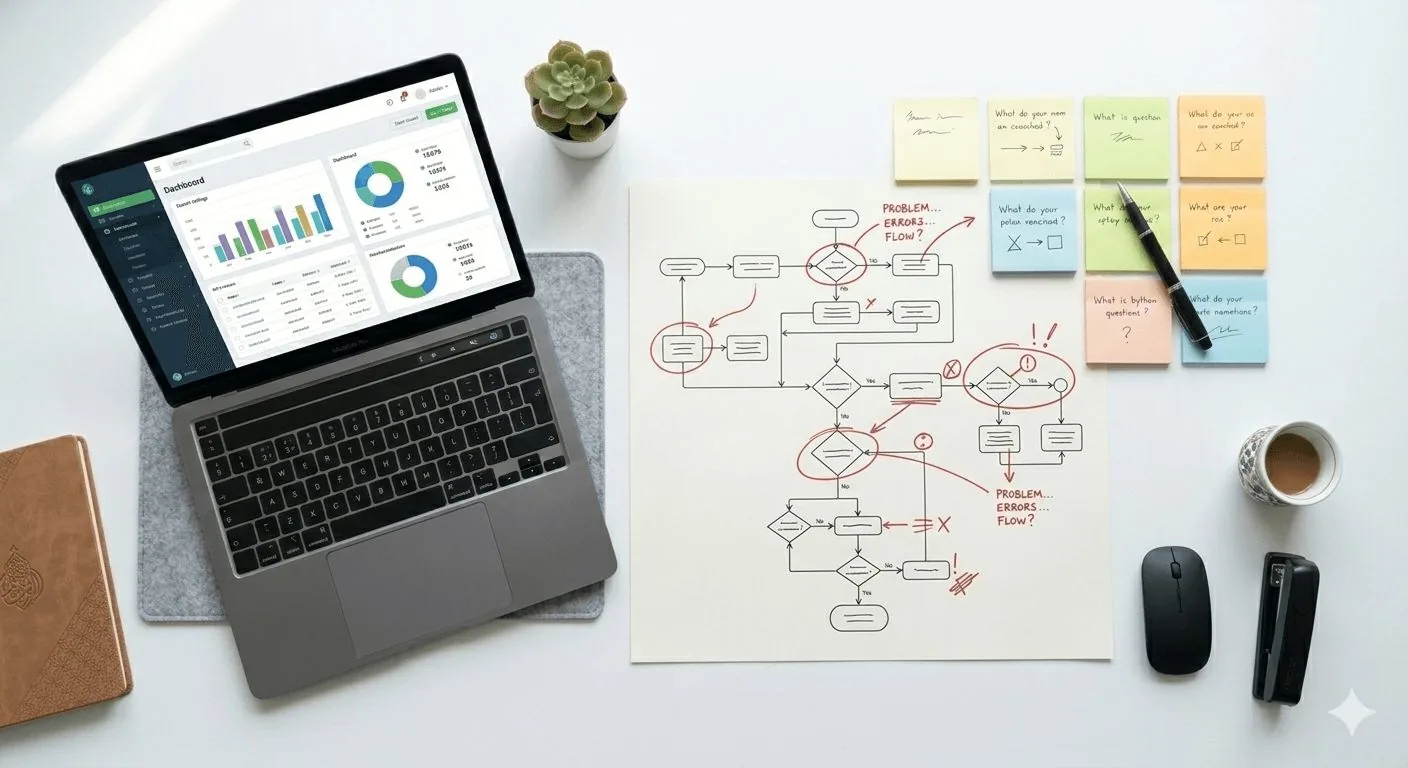

Recognise any of these signs in your business?
At Joyboy, we help UAE businesses identify exactly where process inefficiency is costing them — and build custom solutions that pay for themselves. Let's map out your requirements.