


The conversation around business automation has shifted considerably in the last few years. It used to be dominated by large enterprise case studies — companies with dedicated transformation budgets and internal technical teams implementing complex robotic process automation programs over eighteen-month timelines. That made automation feel like something for a different category of business.
That's no longer the reality. The tools available in 2026 make meaningful automation accessible to businesses of almost any size, and the UAE business community has been faster than most to recognise and act on that shift. But accessibility has introduced a new problem: businesses automating things in the wrong order, automating processes that shouldn't be automated yet, or automating things that genuinely should be left alone — and then drawing the wrong conclusions when the results disappoint.
Getting the sequencing right matters as much as the decision to automate at all. Here is a practical framework for identifying what to automate first, what to leave for later, and what to leave alone entirely.
The Framework: Four Criteria for Automation Readiness
Before deciding whether a process should be automated, it's worth evaluating it against four criteria. Processes that score well on all four are strong automation candidates. Processes that score poorly on one or more need more thought before automation makes sense.
Frequency. How often does this process happen? A process that occurs hundreds of times a day has a very different automation ROI than one that happens twice a month. High-frequency processes generate proportionally higher returns from automation because the time saving compounds across every execution. Low-frequency processes may not justify the build and maintenance cost of an automated solution.
Consistency. Does this process follow the same rules and steps every time, or does it vary significantly based on context, judgment, or exceptions? Consistent, rule-based processes are natural automation candidates. Processes that require judgment, contextual interpretation, or frequent exceptions are harder to automate reliably — and poorly automated judgment calls cause more problems than they solve.
Error sensitivity. What happens when this process goes wrong? A process where errors have significant downstream consequences — wrong information sent to customers, incorrect financial calculations, missed compliance steps — is a strong candidate for automation because removing human error from the equation has high value. A process where occasional errors are easily caught and corrected represents a lower automation priority.
Stability. Is this process well-defined and stable, or is it still evolving? Automating an unstable process locks in its current problems and means that every process change requires a corresponding automation update. Processes that are still being refined should be stabilised before automation investment is made.
The Highest-Value Processes to Automate First
Evaluated against these four criteria, a consistent set of process categories emerges as the highest-value automation priorities for most UAE businesses.
Invoice generation and accounts payable workflows
Few processes in a typical business operation combine high frequency, high consistency, high error sensitivity, and high stability as reliably as financial document processing. Generating invoices from completed orders or project milestones, routing them for approval, sending them to clients, tracking payment status, and triggering follow-up reminders are all rule-based steps that happen repeatedly and where errors — wrong amounts, wrong recipients, missed follow-ups — have direct financial consequences.
Automating invoice generation and the associated payment tracking workflow typically saves significant administrative time and reduces the payment cycle by eliminating the delays that occur when manual processes depend on someone remembering to take the next step. For UAE businesses managing VAT compliance, automation also reduces the risk of errors in tax documentation.
Lead capture and CRM data entry
Every enquiry that arrives through your website, your social media channels, your email, or your WhatsApp business account and gets manually entered into a CRM represents both a time cost and an error risk. Lead data entered manually is often incomplete, incorrectly formatted, or simply not entered at all when the person responsible is busy.
Automating lead capture — routing enquiries directly into your CRM, creating contact records with the available information, assigning leads to the appropriate team member based on defined rules, and triggering an immediate acknowledgment to the prospect — ensures no lead falls through the cracks and no time is spent on data entry that a system can handle in seconds.
Onboarding sequences and client communications
The sequence of communications that a new client or customer should receive — welcome messages, onboarding instructions, check-in touchpoints, satisfaction surveys — is highly consistent and highly schedulable. The content doesn't change significantly between clients, the timing is rule-based, and the consequences of not sending them — a client who feels ignored, a onboarding step that gets missed, an opportunity for early feedback that doesn't happen — are real.
Automating client communication sequences removes the dependency on someone remembering to send the right message at the right time, ensures every client receives a consistent experience, and frees the team to focus on the interactions that genuinely require human attention.
Inventory and stock management alerts
For businesses managing physical inventory, the cost of a stock-out — a product that's out of stock when a customer wants to buy it — is immediate and quantifiable. The cost of over-ordering is equally real. Both problems are preventable with automation that monitors stock levels in real time, triggers reorder alerts or automatic purchase orders when defined thresholds are reached, and updates inventory records as stock moves.
The manual alternative — someone checking stock levels periodically and making reorder decisions based on their current knowledge of the situation — introduces lag, depends on individual availability, and is vulnerable to the kind of oversight that leads to either empty shelves or overstocked warehouses.
Report generation and distribution
The weekly or monthly management report that requires someone to pull data from multiple sources, format it consistently, and distribute it to stakeholders is one of the most consistently automatable processes in any business operation. The data sources are defined. The format is fixed. The distribution list doesn't change. The schedule is regular.
Automating this process — aggregating the relevant data, populating a report template, and distributing it to the right people at the right time — eliminates the time cost of manual report preparation and ensures stakeholders always have current information without depending on someone finding time to compile it.
Approval workflows
Processes that require sign-off from one or more people — expense approvals, leave requests, purchase order authorisation, content sign-off — are strong automation candidates when the routing rules are clear and consistent. An automated approval workflow routes requests to the correct approver based on defined criteria, sends reminders when approvals are pending, escalates when deadlines are missed, and maintains a complete audit trail of who approved what and when.
The manual alternative — routing approvals through email chains or WhatsApp groups — creates delays, loses requests in busy inboxes, provides no audit trail, and makes it difficult to track where in the process a request currently sits.
Processes to Automate Later, Not First
Some processes are genuine automation opportunities but should wait until higher-priority items have been addressed — either because the ROI is lower, the process needs stabilisation first, or the automation complexity is higher than the return justifies at this stage.
Complex customer service interactions. Automating first-line customer service responses — acknowledgment messages, FAQ answers, simple status updates — makes sense and delivers value. Automating the resolution of complex, context-dependent customer issues requires more sophisticated AI capability, more careful design, and more ongoing monitoring than simpler processes. Start with the simple interactions and expand to more complex ones as your confidence in the automation grows.
Processes that are actively changing. If you're in the middle of reviewing and restructuring a process, automate it after the new version is stable. Automating the current version and then having to rebuild the automation when the process changes is an avoidable cost.
Low-frequency, low-error-rate processes. If a process happens infrequently and the manual version works reliably, the automation ROI may not justify the investment at this stage. These processes are candidates for a later phase when higher-priority automation has been completed and the team has the bandwidth to address lower-priority items.
Processes to Leave Alone
Not everything should be automated, and being clear about what belongs in this category is as important as being clear about what doesn't.
Relationship-critical interactions. The call to a key client when something goes wrong. The personal follow-up after a significant deal closes. The conversation with a team member who is struggling. These interactions derive their value precisely from being human and personal. Automating them — or replacing them with automated equivalents that feel personal — destroys the value they're meant to create.
Processes requiring genuine judgment. Assessing a complex proposal, evaluating a candidate for a senior role, deciding how to handle an unusual customer situation, pricing a non-standard project — these require contextual judgment, experience, and the ability to weigh competing considerations in ways that current automation tools cannot replicate reliably. Attempting to automate genuine judgment calls produces brittle, error-prone systems that require constant exception handling.
Creative work. Writing that reflects your brand voice authentically, design decisions that require aesthetic judgment, strategic thinking about where the business should go — these are human activities. Automation tools can support and assist creative work, but they cannot replace it without producing output that lacks the distinctiveness that makes it valuable.
Processes you don't fully understand yet. If you can't describe the rules of a process clearly enough to explain them to someone who has never seen it before, you can't automate it reliably. Automation encodes the rules of a process in software — if the rules aren't clear, the automation won't be either. Understand the process thoroughly before attempting to automate it.
Starting the Right Way
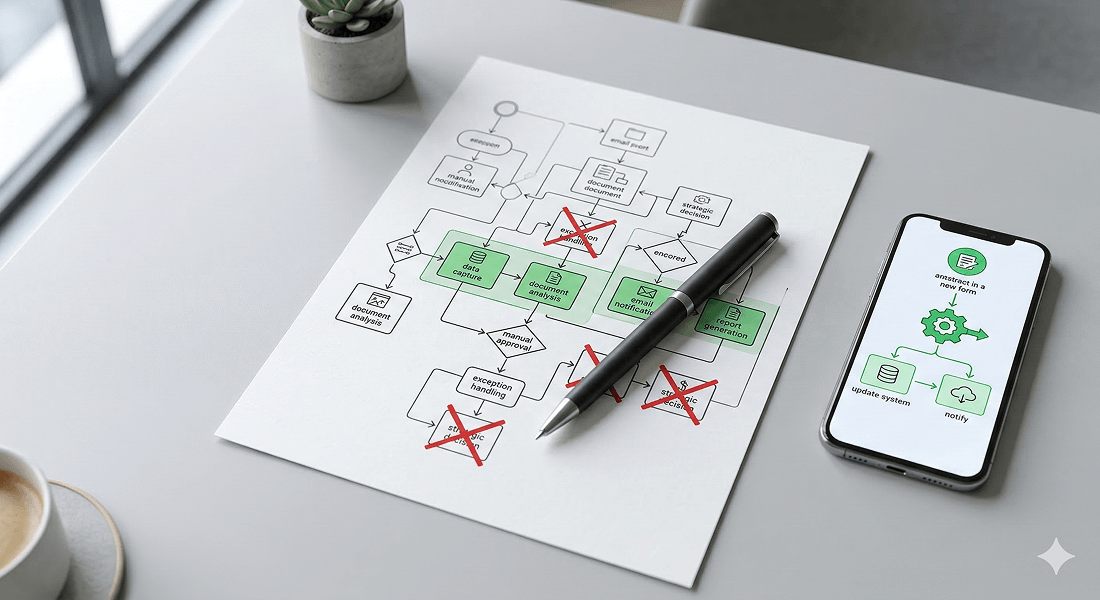
The businesses that get the most value from automation are the ones that approach it systematically rather than reactively. Rather than automating whatever seems most annoying in the moment, they map their processes, evaluate them against consistent criteria, sequence the automation work by value and readiness, and treat each implementation as something to measure and learn from.
The first automation you implement successfully builds organisational confidence. It demonstrates that the approach works, produces a measurable return, and creates appetite for the next one. That momentum is valuable — and it starts with getting the first choice right.
Start with something high-frequency, highly consistent, clearly rule-based, and stable. Implement it properly, measure the result, and use what you learn to inform the next priority. That is how automation compounds from a useful tool into a genuine operational advantage.

Not sure where to start with automation in your business?
At Joyboy, we help UAE businesses identify the highest-value automation opportunities and implement them in the right sequence — so the investment pays back quickly and compounds over time. Talk to us about your processes.